● Open to research opportunities & collaborations
Hello, I'm
Tuan Anh Vu
Ph.D. Researcher in Survival Analysis & Artificial Intelligence
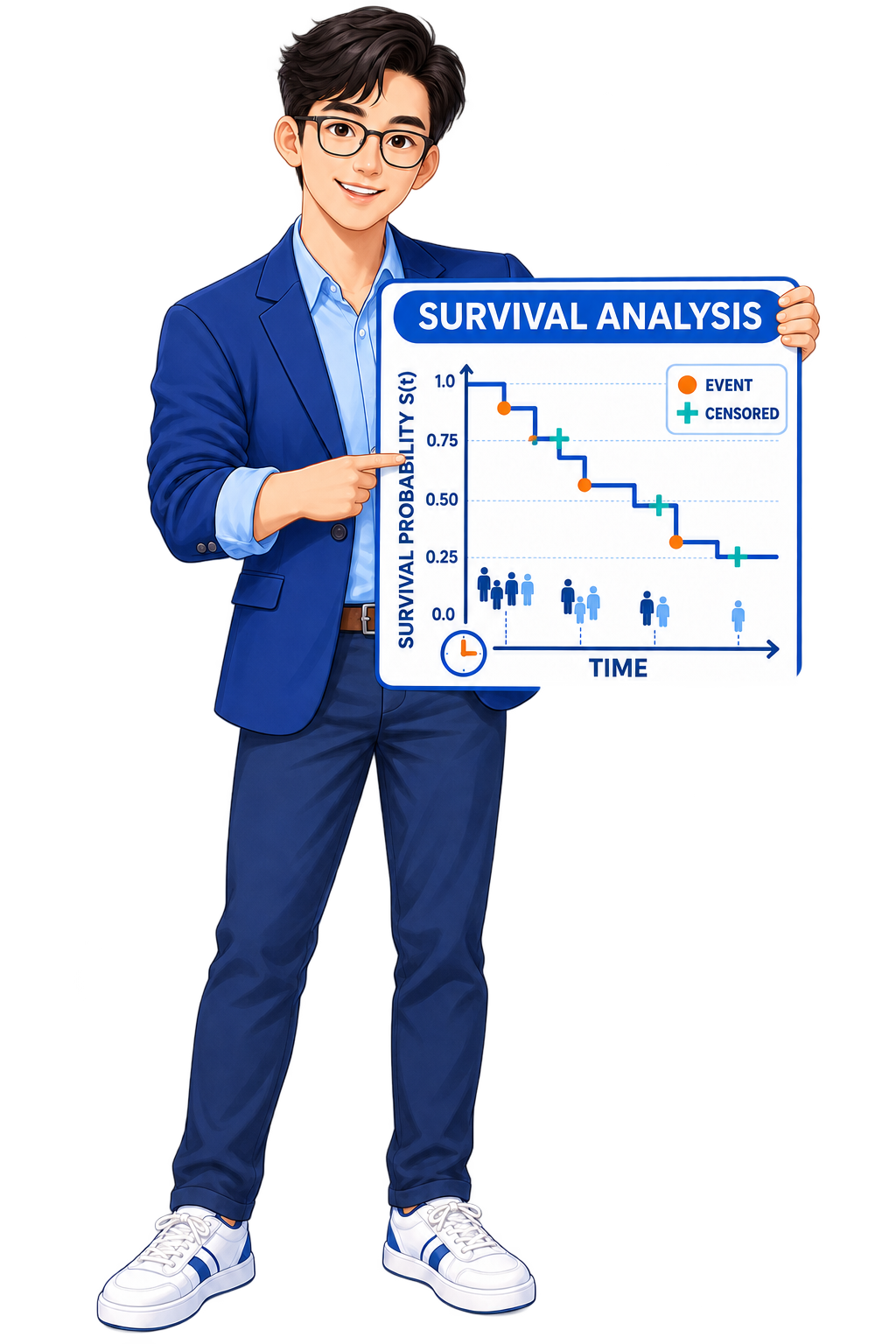
I develop statistical and AI models for time-to-event data—such as time to disease recurrence or equipment failure—even when follow-up is incomplete.
NameTuan Anh Vu
RolePh.D. Researcher
InstitutionPukyong National University
BasedBusan, Republic of Korea
Survival analysis in practice
What can we learn from the time before an event?
An “event” can be a disease returning, a machine failing, or a customer canceling a subscription. I develop models that estimate when these events may occur and how that timing varies across people or systems.
1Observe a starting pointFor example, treatment ends or a machine begins operating.
2Measure time to an eventWe record when the event occurs—or when observation ends without seeing it.
3Support a real decisionThe prediction can inform follow-up, maintenance, or timely intervention.
From demo data to an interpretable risk analysis
Follow the four steps below to explore the data, fit a model, and understand its output.
Demo dataset
Breast cancer recurrence example
An educational cohort created to demonstrate the analysis workflow. The analytical goal is to predict recurrence-free survival.
…demo records
8input features
…demo events
ageAge
Patient age at baseline
yearshorThHormonal therapy
Whether hormonal therapy was administered
yes / nomenostatMenopausal status
Status recorded at baseline
pre / posttsizeTumor size
Measured primary tumor size
millimetrestgradeTumor grade
Ordered pathological grade
I / II / IIIpnodesPositive nodes
Number of positive lymph nodes
countprogrecProgesterone receptor
Tumor receptor measurement
fmolestrecEstrogen receptor
Tumor receptor measurement
fmolWhy ordinary regression is not enough
For δ=0, the true event time is unknown—not zero and not equal to the last follow-up. Survival methods retain this partial information instead of discarding or mislabelling it.
01
About
Statistical foundations.
Modern learning systems.
I am a Ph.D. student in the Department of Artificial Intelligence Convergence at Pukyong National University (PKNU), Republic of Korea. I received my B.Sc. in Computer Science from Dongguk University and my M.S. in Artificial Intelligence Convergence from PKNU.
My research lies at the intersection of survival analysis, statistical machine learning, and deep learning. I develop flexible neural models for right-censored time-to-event data, including hazard-based and accelerated failure time formulations.
I also study how survival models can be integrated with reinforcement learning to support sequential decisions. More broadly, my work combines the statistical foundations of survival analysis with the representation-learning and optimization capabilities of modern machine learning.
02
Research focus
I develop statistical and machine-learning methods for predicting time-to-event outcomes from complete and right-censored observations.
Survival Analysis & Time-to-Event Modeling
Estimating when events occur while correctly accounting for right-censored follow-up.
Deep Survival Analysis
Building neural hazard and accelerated failure time models for complex nonlinear patterns.
Statistical Machine Learning
Combining statistically valid objectives with modern representation learning.
Structured & High-Dimensional Data
Making robust predictions from tabular data and high-dimensional covariates.
Reinforcement Learning for Censored Data
Learning sequential treatment policies when time-to-event outcomes are censored.
03
Publications
01
CNN-Based Approaches for Various Types of Tabular Data
02
A Multi-Modal CNN Approach for High-Dimensional Survival Data
03
Understanding Frailty Effect in Frailty Models Using frailtyHL R Package
04
Selected projects
Current and completed work on building flexible models, learning from incomplete follow-up, and supporting decisions over time.
01
Ongoing
Deep M-Spline Models for Survival Analysis
Developing flexible neural survival models that capture nonlinear covariate effects while representing the baseline hazard or survival distribution with M-splines and I-splines.
- PyTorch
- M-Splines
- I-Splines
- PH & AFT
- Maximum Likelihood
02
Ongoing
Reinforcement Learning for Censored Survival Outcomes
Adapting Q-learning and Bellman optimization to right-censored time-to-event outcomes for individualized sequential decision-making.
- Survival Analysis
- Q-Learning
- AFT Models
- Censoring Adjustment
03
Completed
CNN-Based Learning for Tabular Data
Investigated convolutional architectures and data representations for several types of tabular data; published in IEEE Access in 2025.
- Python
- Deep Learning
- CNN
- Tabular Data
05
Methods & tools
Programming
Python · R · SQL · LaTeX
Statistical Modeling
Cox PH · AFT Models · Frailty Models · Censored Data · Maximum Likelihood · Splines
Machine Learning & Deep Learning
PyTorch · scikit-learn · Neural Networks · CNNs · Deep Survival Analysis · Model Evaluation
Reinforcement Learning
Q-Learning · Deep Q-Learning · Bellman Equations · Sequential Decisions · Treatment Strategies
Scientific Computing
NumPy · pandas · SciPy · Simulation Studies · Reproducible Experiments
Research
Academic Writing · Literature Review · Experimental Design · Statistical Simulation · Research Visualization
Tools
Git · GitHub · Linux · Docker · VS Code · Jupyter Notebook
06
Journey
Research experience
Present
Ph.D. Researcher
Pukyong National University
Developing deep survival models, designing simulation studies, comparing statistical and machine-learning methods, and investigating reinforcement learning with censored outcomes.
Previous
Graduate Researcher
Pukyong National University
Research in machine learning, high-dimensional survival analysis, CNN-based modeling, and statistical survival methodology, contributing to peer-reviewed publications.
Education
Ongoing
Ph.D. in Artificial Intelligence Convergence
Pukyong National University (PKNU)
Advisor: Prof. Il Do Ha. Research in survival analysis, statistical machine learning, deep learning, and reinforcement learning for censored time-to-event data.
Completed
M.S. in Artificial Intelligence Convergence
Pukyong National University (PKNU)
Graduate research focused on machine learning and survival analysis under the supervision of Prof. Il Do Ha.
Completed
B.Sc. in Computer Science
Dongguk University
Built a foundation in computer science, programming, algorithms, data analysis, and machine learning.
Research conversations welcome
Let's talk about time-to-event data.
I welcome research collaborations in survival analysis, statistical machine learning, and methods for right-censored time-to-event outcomes.
Email me at guidetuanhp@gmail.com